Retaining Wall Repair in Cedar Rapids, IA
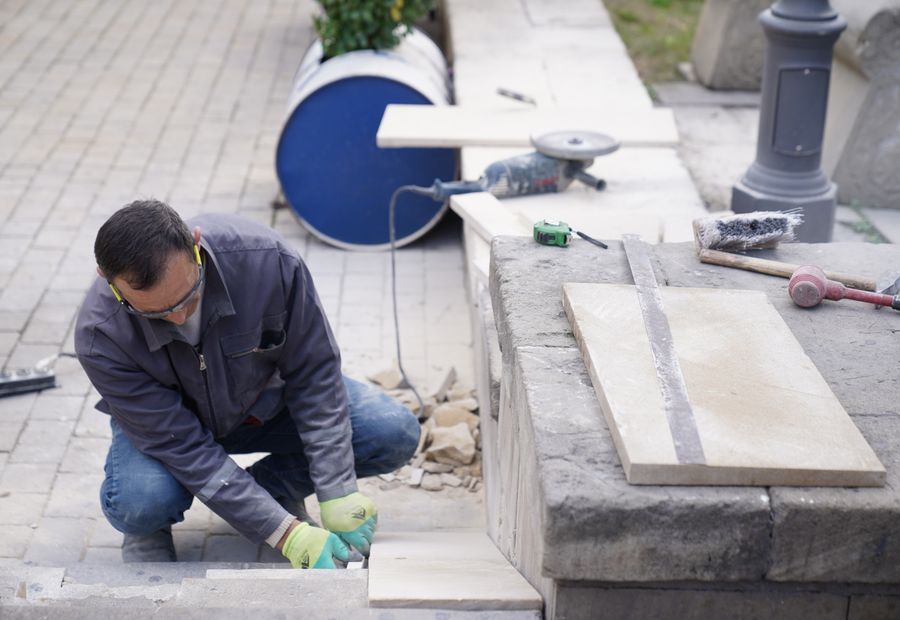
Cedar Rapids Retaining Walls is a retaining wall repair contractor doing wall rebuilds, segmental block walls, timber wall replacement, boulder and natural stone walls, wall drainage correction, terracing, and commercial and HOA wall work. We serve houses, acreages, and multi-family property across Cedar Rapids, Marion, Hiawatha, Mount Vernon, Robins, Ely, and Linn County, Iowa.
We rebuild in Versa-Lok, a solid pinned unit our crew cuts on site for curves, corners, and steps. Clean angular drainage stone fills the space behind the block from the bottom course to the top. Filter fabric holds the native soil off that stone so silt never closes it. A sleeved perforated pipe sits at the base of the stone column and runs on a slight fall to daylight. Taller runs get Tensar UX geogrid laid between courses and back into the hill, at a length set by wall height and the soil behind it. Set that against block dry-stacked on dirt with clay shoveled straight against the back. Cedar Rapids crosses the freezing mark and back again many times each winter. Water trapped in that clay freezes, swells, and walks a wall out a little further every cycle.
Water Is What Puts a Wall Down
Dry soil pushes, and a wall is built for that push. Saturated soil pushes much harder, because the water carries its own pressure. Ground here is loess and clay over glacial till, and it holds water well. The slopes rising away from the Cedar River are where the walls are, and the older hill blocks around Wellington Heights and Bever Park carry plenty of them.
Reading the Damage
A lean means the top has rotated outward. A bulge means one stretch let go while the ends held. Stair-step cracking says the ground under the base moved. Joints opening between units say the run is pulling apart along its length. A drop at the toe means the base failed under it.
Reset, Section, or Full Rebuild
Sound block gets reused, because segmental units are concrete and do not wear out. That puts the cost in excavation, base, stone, pipe, grid, and labor instead of a yard of new material. We rebuild one bay where the rest of the run is straight and drained. We rebuild the whole line where it is not. We do not sell shortcuts that straighten a face and bury the reason it moved.
Caps, Stains, and Outlets
Loose caps come off, get cleaned, and go back down in fresh adhesive. The white bloom on a block face is efflorescence, salt that water carried out of the concrete, and it comes off the surface. A drain outlet plugged with silt, mulch, or ice stops the entire system, so we find the end of the pipe and open it.
Booking
One boundary: we hold the hillside outside your house. A bowing basement wall belongs to a foundation contractor. We measure and quote all winter and build once the frost is out. (319) 555-0129 reaches a person.
Can a leaning retaining wall be repaired?
Not by pushing it back. A wall that has leaned also lost its alignment, and almost always its base and its drainage stone. What works is taking the moved section apart and resetting it on a rebuilt base, and that only works where the lean is small and confined to one bay. A wall that has bulged in the middle, rotated at the top, or dropped at the bottom needs a rebuild of that run. Any fix that straightens the face without opening the back leaves the cause sitting right where it was.
Why is my retaining wall leaning or bulging?
Water, nearly every time. Wet soil pushes far harder than dry soil, because the water adds its own pressure on top of the earth pressure. The build faults that let it happen are always the same short list: no clean stone behind the wall, no pipe carrying water out, no compacted base under the first course, no buried course at the toe, and no grid on a wall tall enough to need it. Load added above the wall after it was built does the rest.
How long does a retaining wall last?
It depends on the material and the drainage. Timber runs roughly fifteen to twenty years in Iowa before the buried parts give out. Segmental block runs decades. Stone laid well outlasts the crew that laid it. Drainage decides more than material does, and the walls that die young are the ones with dirt packed against their backs.
How much does a retaining wall cost per foot?
Walls price by face foot, which counts the buried wall as well as the wall you can see. That is why doubling the height more than doubles the cost. Timber sits at the bottom of the range, segmental block in the middle, poured concrete above that, and natural stone at the top. Height, run length, how much hill has to come out, whether a machine can reach the work, and anything sitting above the wall all move the figure. We give you a number for your wall, not an average.