Segmental Block Retaining Walls in Cedar Rapids, IA
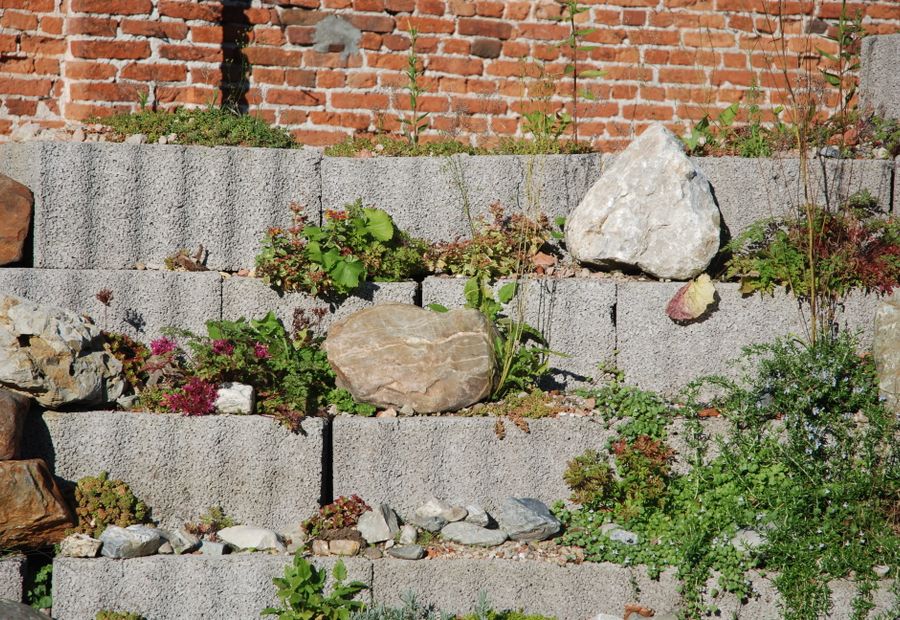
Cedar Rapids Retaining Walls builds segmental block retaining walls for sloped lots, walkouts, driveways, patios, and garden terraces throughout Cedar Rapids, Marion, Hiawatha, Robins, Mount Vernon, and the rest of Linn County, Iowa. We build new walls, and we rebuild block runs that were put up without a base or a drain.
Two systems cover most of what we build. Allan Block units are hollow, and the cores get filled with the same washed angular stone that fills the space behind the wall, so the drainage column runs through the wall body instead of only behind it. Versa-Lok units are solid and pinned, and a crew shapes them on a saw for radius work, steps, and column ends. Both dry-stack, which means the wall flexes with the ground rather than cracking against it. StrataGrid sheets go in between courses on the taller runs. A wall built the other way, units set on scraped dirt with the hill pushed in behind, has nowhere for water to go, and water is the load that grows in a Cedar Rapids winter.
The Base Is Half the Wall
We trench below grade, compact the subgrade, then lay and compact angular gravel, roughly half a foot deep and about a foot wider than the block, deeper as the wall grows. Then it gets leveled, and level here means checked across the whole run before a single unit lands. A base laid on soft or wet subgrade settles later, and a settled base cracks everything above it.
How the Courses Lock
Pins, lips, or both hold each course to the one under it and set the setback at the same time. That built-in setback is batter, and it leans the wall back into the hill so the wall's own weight works against the push instead of with it. A wall stacked dead plumb starts life with less margin than a battered wall that has already given ground.
Grid, Stone, and Pipe
Grid sheets lay flat on a course, get pinned by the course above, and run back into compacted fill. Length comes off the wall height and the soil, not off a habit. Stone fills behind the units top to bottom, fabric keeps the dirt out of it, and a perforated pipe at the bottom carries the water to daylight.
Caps and Finish
Cap units get cut to the line and set in a flexible masonry adhesive, and the top of the wall gets graded so surface water runs away from the face rather than over it. We stake and lay out the run with you before anything gets dug. (319) 555-0129 starts a quote.
Why does the first course get buried?
Because the buried course is what stops the bottom of the wall from kicking out. The rule of thumb is about an inch of block below grade for every foot of finished wall height, and never less than about half a foot. A wall that starts flush with the lawn has nothing holding its toe, and the toe is where failure starts.
Does every block wall need geogrid?
No. Short garden walls with nothing loaded above them stand on their own weight and their base. Grid becomes necessary as the wall gets taller, and sooner than that when a driveway, a pool, a shed, or another slope sits above it. Grid also has to run far enough back to catch a real wedge of the hillside. Sheets that stop a couple of feet in are decoration.
Can you build curves, corners, and steps into a block wall?
Yes. Segmental units are made for it. A curve comes from the taper on each unit, and a tight radius gets units cut on a saw right at the wall. Outside corners use manufactured corner units or field cuts. Steps through a wall get their own base and their own drainage, because the tread pad is a separate structure sitting in front of the hill.
Why choose block over timber?
Service life, mostly. Timber is the cheapest wall per face foot and the shortest lived, because the face rots at the ground line and the buried deadmen rot where nobody sees them. Block is concrete, so nothing behind it is waiting to decay. A block wall built on a compacted base with stone and a pipe behind it runs decades with no maintenance beyond the caps.